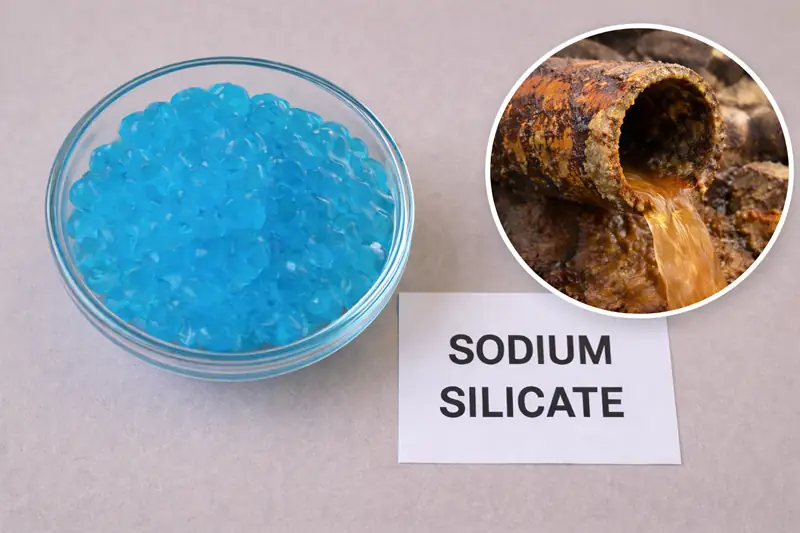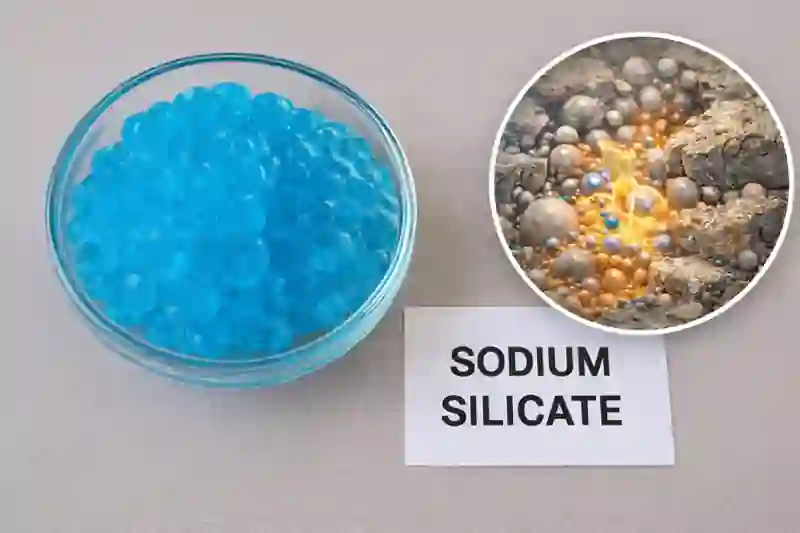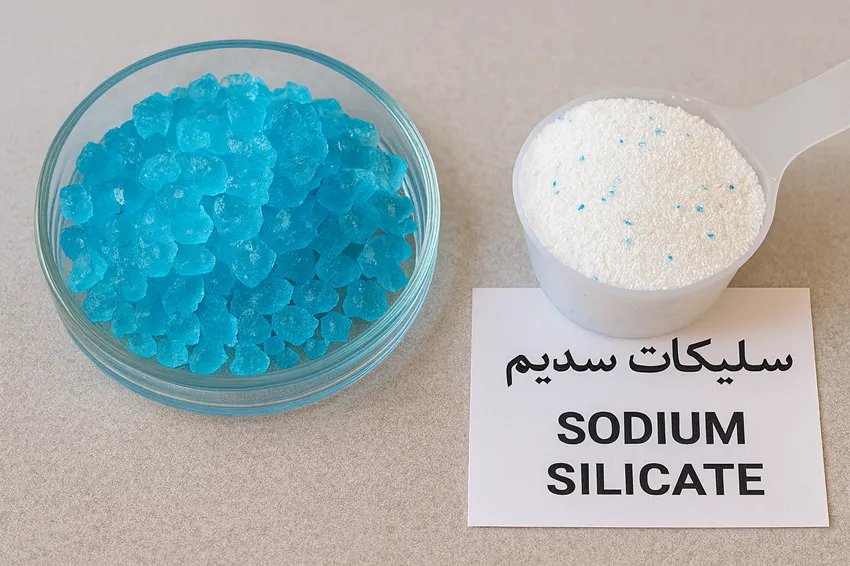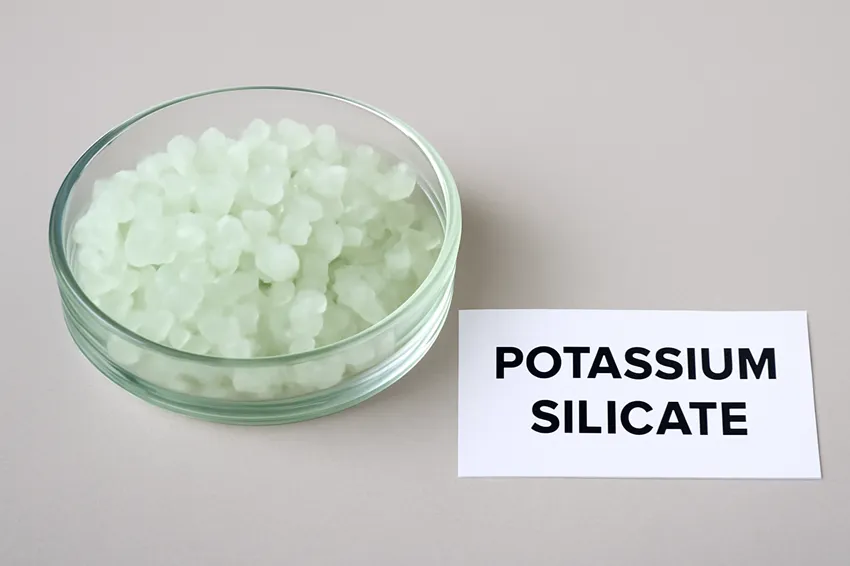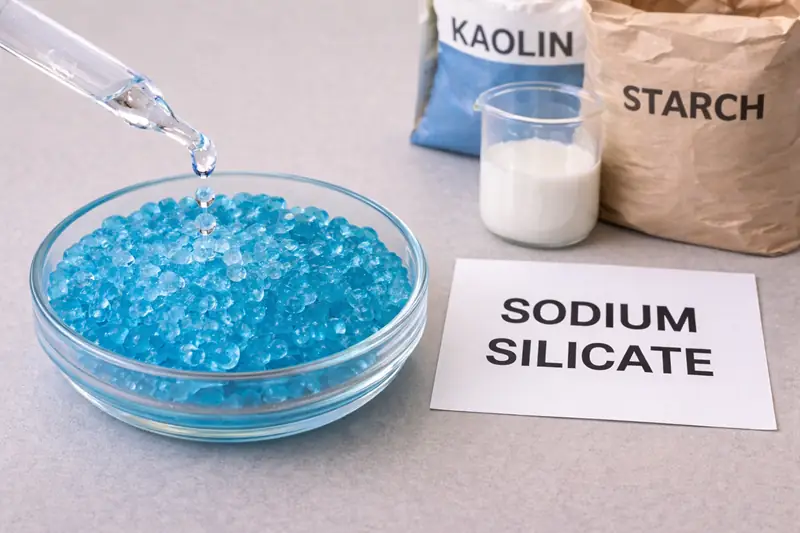
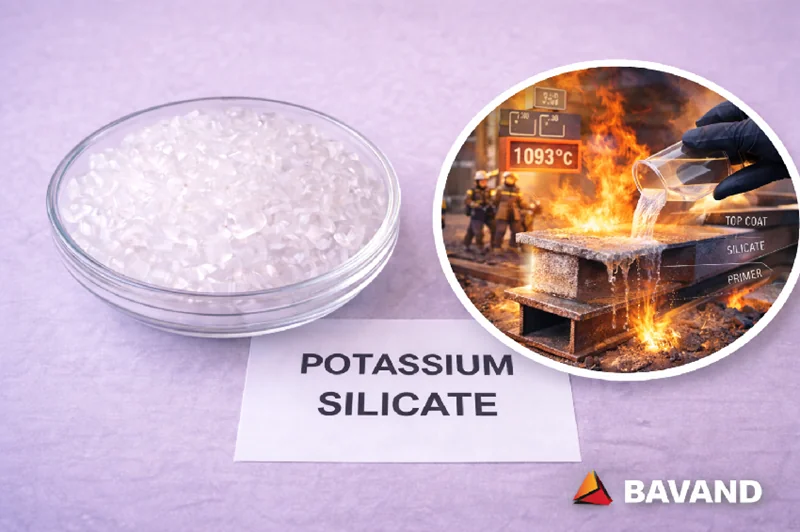

When sheet brightness fluctuates, downtime rises, and costs keep squeezing, you don’t always need risky, high-impact changes. A multi-functional additive like sodium silicate can help “steady the rhythm” of your line: cleaner deinking, more economical bleaching, stronger bonding, and more uniform coating. Bavand Chemical Company is one of the sodium silicate manufacturers in Iran , by offering a wide range of grades (controlled moduli, 35–40% solids) and pilot support, makes reliable implementation on the production line much easier.
Applications of Sodium Silicate in the Paper Industry
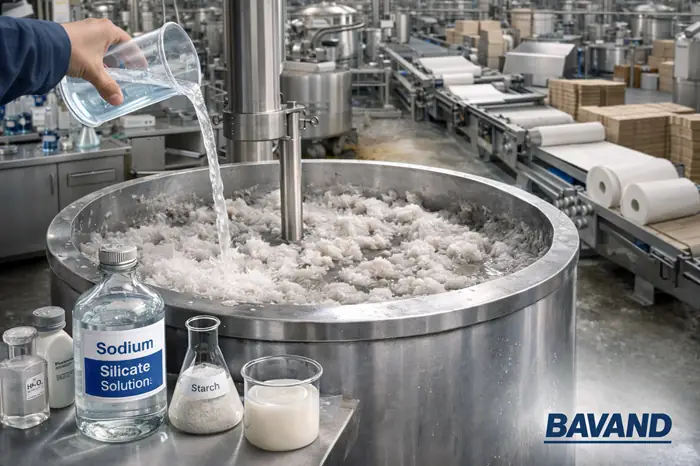
Sodium silicate—whether as solid sodium silicate (flakes/powder) or liquid sodium silicate (aqueous solution)—is essentially an alkaline SiO₂/Na₂O system with an adjustable silica modulus.
That’s why liquid sodium silicate and solutions made from solid sodium silicate can act as a pH buffer, a dispersant, a peroxide stabilizer, and also a component in adhesive/coating formulations.
Bavand Chemical supplies both solid and liquid forms of sodium silicate in grades with low interfering metals (controlled Fe/Cu) to preserve H₂O₂ stability during bleaching processes.
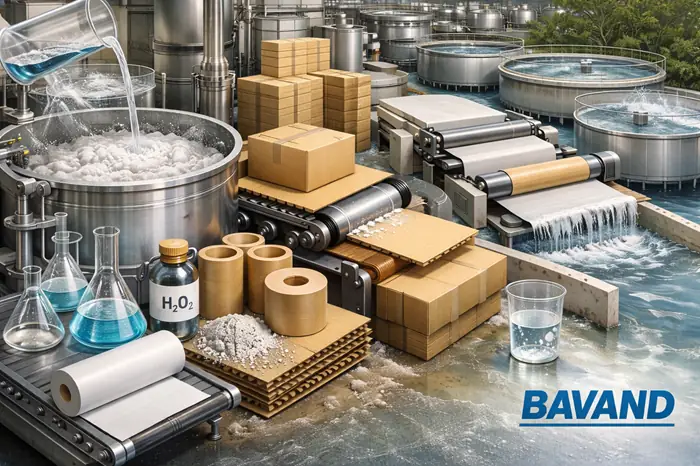
In each application below, we highlight roles and expected outcomes to make implementation clearer.
1) Deinking & peroxide bleaching of recycled pulp (Deinking & Peroxide Bleaching)
Bavand Chemical implementation suggestion: Use silicate together with a low-dose chelant and inject after alkali addition to maximize peroxide efficiency.
2) Stickies & pitch control (Stickies/Pitch Control)
Practical note: Accurate dosing and conductivity monitoring prevent silica gel formation; Bavand Chemical’s technical team calibrates injection points.
3) Starch & silicate adhesives (Starch & Silicate Adhesives)
Bavand Chemical service: Laboratory tuning of the adhesive formulation based on local starch and your line conditions.
4) Coating & pigment dispersion (Coating/Dispersion)
Note: To avoid conductivity increase/gel risk, mixing temperature and order of addition should follow Bavand Chemical instructions.
5) Water & effluent (Water & Effluent)
Bavand Chemical approach: Continuous dosing design and online soluble-silica monitoring to maintain stable water quality.
Advantages
If you aim to simultaneously improve brightness, machine cleanliness, interlayer bond strength, and coating uniformity, sodium silicate is a precise, scalable, and economical choice and with Bavand Chemical’s stable supply and technical services, results come faster.
Compact application table (Use–Benefit–Risk–Dose)
|
Area |
Key roles of silicate |
Benefits |
Pitfalls/Risks |
Starting dose |
|
Deinking/Bleaching |
pH buffer, H₂O₂ stabilization, ink dispersion |
Higher brightness, optimized peroxide use, cleaner process |
Too high pH → fiber damage/yellowing |
0.5–3% (dry basis) |
|
Stickies/Pitch |
Controlled alkalinity + dispersion |
Fewer spots/stops, cleaner machine |
Colloidal instability at high dose |
0.1–0.5% (system) |
|
Starch adhesive |
Set time/viscosity control, bond reinforcement |
Better ECT/RCT, higher line speed |
Brittleness at high dose |
5–15% of 35–40% solution |
|
Pure silicate adhesive |
Mineral bonding, VOC-free, repulpable |
Stable performance, improved fire safety |
Moisture sensitivity/brittleness |
20–40% base |
|
Coating |
Pigment dispersion, uniform coating |
Smooth surface, controlled opacity |
Higher conductivity/gel risk |
0.1–1% vs. pigment |
|
Water/Effluent |
pH adjustment, aids coagulation |
More stable water chemistry, better treatment |
Silica precipitation at high dose |
Based on water analysis |
Bavand Chemical provides CoA for each batch and advice on selecting the right modulus for each application.
Bavand Chemical’s team documents the dosing layout, dilution scenario, and optimal conductivity limits for your line.
Challenges: Long adhesive set time, delamination on the evening shift, high starch consumption, reduced ECT under humidity.
Solution: Redesign the starch adhesive with 10% of 38% silicate solution (modulus 3.1), set pH 10.8, adjust gelatinization temperature, add a low-dose plasticizer (per Bavand Chemical’s recommended instructions).
6-week results:
With a targeted formula change aligned with Bavand Chemical’s guidelines, multiple benefits were achieved at once: better economics + higher strength + smoother production rhythm.
Safety documents (SDS) and transport guidelines are available from Bavand Chemical.
Bavand Chemical provides industrial samples, in-line pilot trials, and scheduled operator training.
By smartly implementing key applications and leveraging the standout advantages of sodium silicate from cleaner deinking to stronger bonding and more uniform coating—you can stabilize quality, reduce stoppages, and control costs. Bavand Chemical’s support in grade selection, formulation, and monitoring makes the path faster and more reliable.
For specialized consultation, consumption/dosage estimation, and export price inquiry for Bavand Chemical liquid or powdered sodium silicate, fill out the order form on the website or contact our sales department.