
Did you know that in the latest fire-safety statistics, the “home-fire death rate per 1,000 reported fires in 2023” has been reported at around 8.7, and has increased compared with the previous year? That single number is enough to remind us that fire is still not something to take lightly. In a crisis, what truly saves lives is time: a few more minutes to evacuate, a few more minutes for emergency teams to arrive, and a few more minutes to prevent structural collapse. This is exactly where potassium silicate in fire-resistant coatings stops being a technical term and becomes a strategic decision especially when the right quality and grade of raw material is selected and the project execution is properly engineered.
(From zero to selection, purchasing, and correct application)
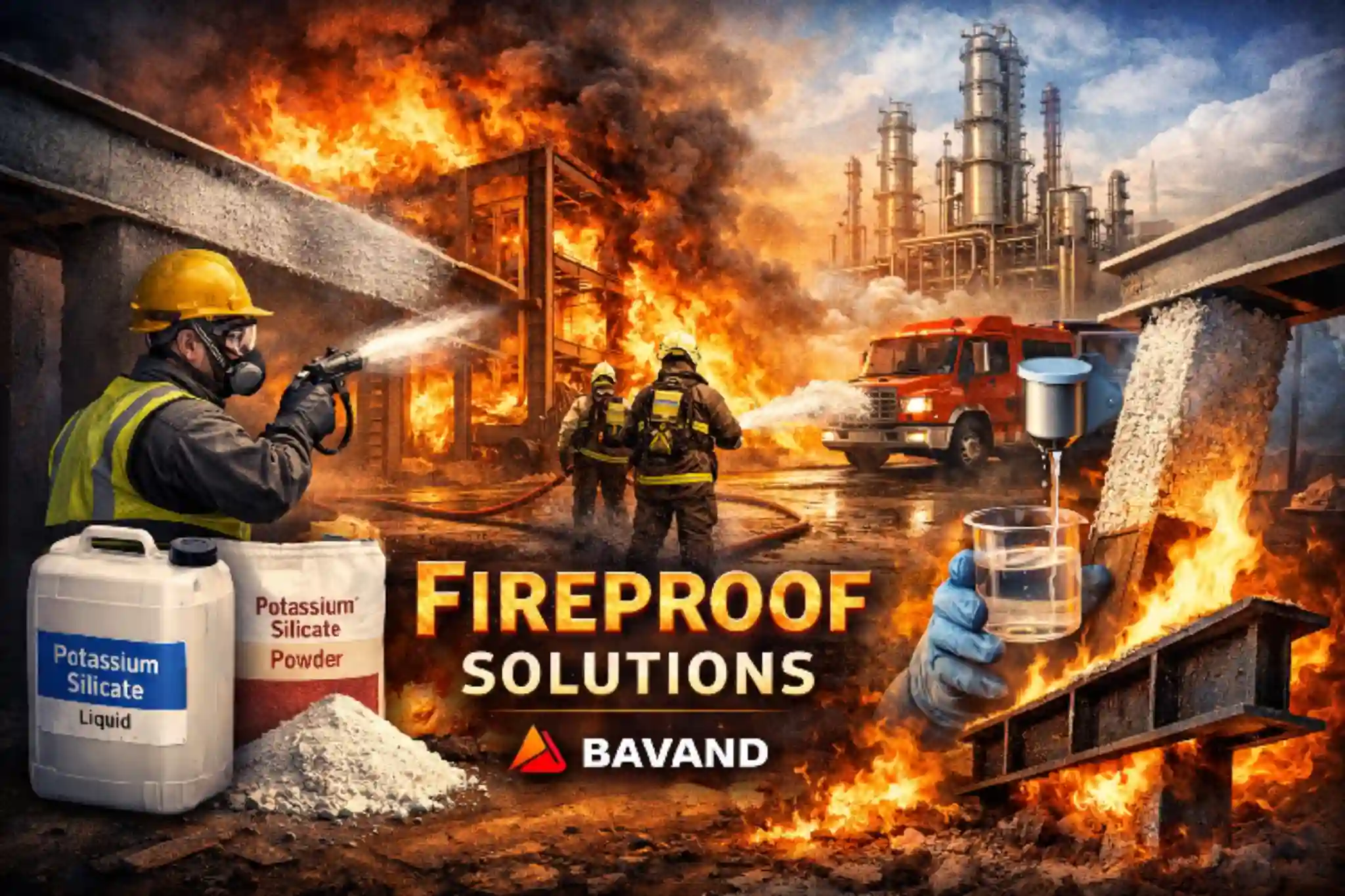
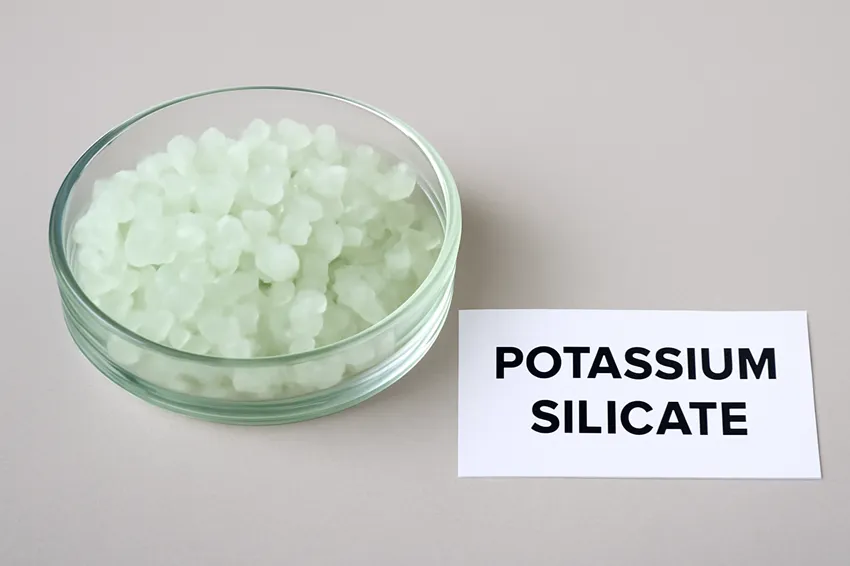
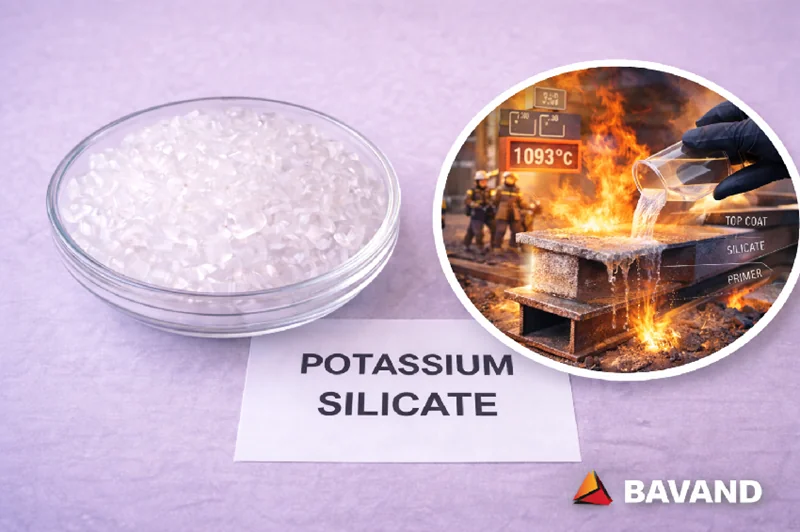
Potassium silicate is, in short, a mineral binder that is typically found in the market in two forms:
1. Liquid potassium silicate (ready-made solution)
2.Solid potassium silicate (alkali glass / powder that is dissolved at the point of use)
Because of its mineral nature and specific thermal behavior, this material has attracted attention in certain industrial coating systems and in the design of fire-resistant coatings.
Because choosing the form affects things like ease of transport, storage stability, viscosity control, and formulation accuracy. In industrial projects, these details can be the difference between a smooth application and a project full of rework.
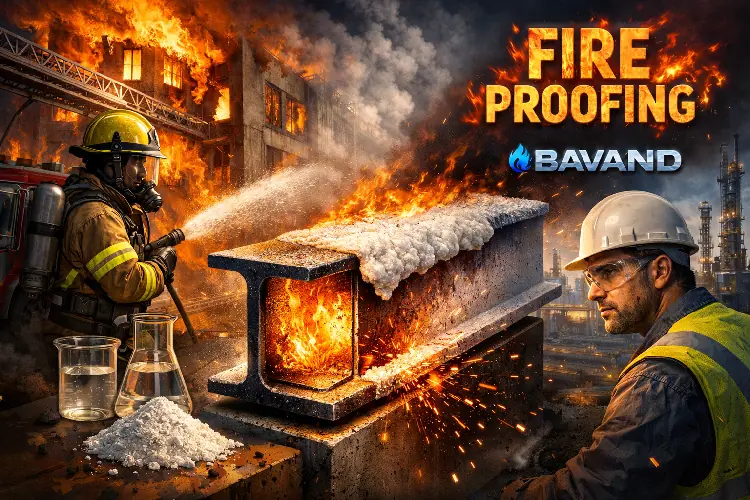
Because in a fire, we are dealing with a heat transfer problem. Steel loses strength quickly at high temperatures, and without sufficient protection, a structure can enter the danger zone very fast.
The idea behind fire-resistant coatings (especially passive fire protection) is to:
·slow down heat transfer,
·create a stable protective layer,
·and buy time.
Potassium silicate, as a mineral binder, has the potential to form layers with suitable behavior at elevated temperatures this is what brings it into the “fire-resistant coating” game.
When a fire starts, a successful coating usually does three things:
Many systems aim to form a porous/insulating layer on the surface so heat reaches the substrate more slowly.
Depending on the formulation, some silicate-based coatings can undergo controlled swelling when heated and increase in volume. This increases the effective insulation thickness.
If the layer cracks or delaminates at high temperatures, protection is effectively lost. That’s why adhesion, controlled flexibility, and thickness design are critical.
Very short takeaway: Potassium silicate shines in fire-resistant coatings when you achieve both insulation and layer integrity during application.
The exact formula varies by manufacturer, but common components typically include:
·Binder: potassium silicate (liquid or dissolvable solid)
· Mineral fillers: for thermal stability, crack control, and improved mechanical properties
·Rheology additives: to control sprayability, sagging, and film uniformity
· Fibers or reinforcements: to increase crack resistance
· Topcoat (if needed): for moisture, UV, and environmental conditions
If potassium silicate is going to deliver results in a fire-resistant coating, these three parameters are often decisive:
1.Modulus (SiO₂ to K₂O ratio)
2. Total solids content (Total Solids)
3. Viscosity and pH (for formulation compatibility and practical application)
These are the factors that influence curing time, adhesion, cracking, and even insulation performance.
Common advantages of potassium-silicate-based approaches in fire-resistant coatings may include:
·Mineral nature and potential for more stable behavior at high temperatures
·Ability to design insulating/expanding coatings (depending on formulation)
· Availability in liquid and solid forms (flexibility in supply and application)
·Suitable for many industrial scenarios where functional durability is the priority
To make a professional decision, read this section carefully:
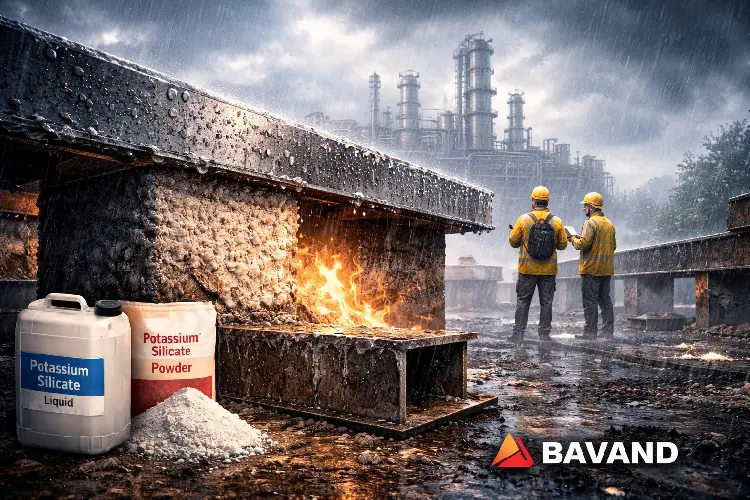
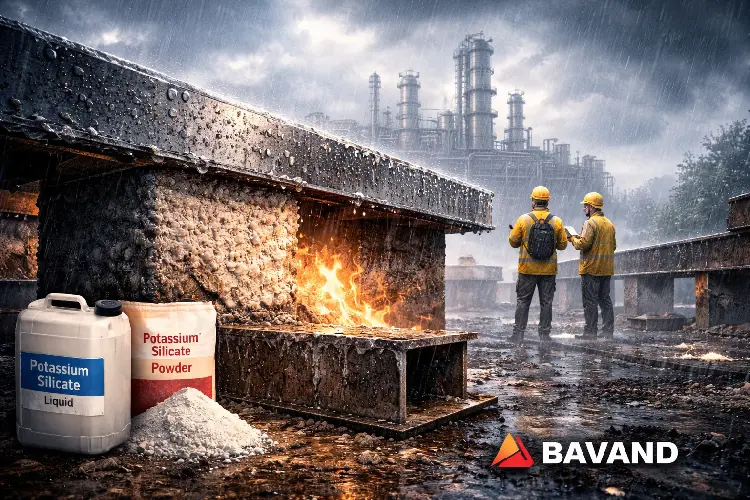
·Sensitivity to moisture/water can be an issue in some silicate systems; for outdoor or humid projects, a topcoat and multilayer design may be required.
·Crack control at high thickness: applying several thin coats is usually safer than one very thick coat.
·Curing depends on environmental conditions: temperature and humidity can change the final result.
·Alkalinity: for job-site safety, take PPE (gloves/eye protection/ventilation) seriously.
When we say potassium silicate in fire-resistant coatings, you may be dealing with one of these families:
Typically used for industrial applications and projects where mineral nature and thermal behavior are especially important.
These systems usually aim to increase high-temperature stability and improve mechanical properties control.
For outdoor projects or humid environments, this model is often more logical.
One of the most common mistakes is assuming that “all fires are the same.”
In European classification, building elements are rated based on their ability to maintain:
·R (load-bearing capacity)
· E (integrity and prevention of flame/hot gas passage)
· I (thermal insulation)
Classes are expressed like REI 60 or R90.
These are typically used for standard building fire exposures and for evaluating elements/assemblies.
In UL 1709, temperature rises extremely quickly (often cited as around 1093°C within 5 minutes). This means if your project is in a hydrocarbon scenario, you cannot make decisions with the same “building fire” mindset.
Practical result: Before selecting potassium silicate in a fire-resistant coating (or any other system), clearly define whether your target is a building scenario or a hydrocarbon/industrial scenario.
Practical comparison table
|
Criterion |
Potassium silicate in fire-resistant coating (mineral/silicate) |
Organic intumescent coating (epoxy/acrylic) |
SFRM / fire boards |
|
High-temperature behavior |
Potential mineral insulation; depends on formula and application |
Forms an organic char; sensitive to resin type |
Physical insulation; good performance but depends on adhesion |
|
Moisture & outdoor exposure |
May require a topcoat |
Usually easier to manage (depending on system) |
Some types are sensitive to moisture/impact |
|
Final appearance |
Industrial to moderate |
Often better and more decorative |
Usually rough/industrial |
|
Application QC |
Requires thickness/curing control |
Requires thickness control |
Requires adhesion/density control |
|
Typical applications |
Industrial, infrastructure, special conditions |
Commercial/building |
Warehouses, parking structures, large spaces |
A simple truth: in many projects, failure isn’t due to “bad material,” but due to an unsuitable grade and insufficient information.
If potassium silicate is going to work in your fire-resistant coating project, the raw material must be procured with precise specifications. In Iran’s market, Bavand Chemical that it produces both liquid and solid potassium silicate, and this variety can be useful for projects that require grade selection.
From the supplier (including Bavand Chemical or any other reputable provider), ask for exactly these items:
This is where projects either succeed or fall apart.
· Complete degreasing
· Removal of dust and contamination
· Creating the proper surface profile according to the system instructions
· Ensuring the surface is dry before application
· If it’s a multilayer system, check chemical compatibility between the primer and the fire-resistant layer.
·On steel, an unsuitable primer can destroy adhesion.
·Multiple thin coats = lower cracking risk
·Measure DFT at multiple points and record it in QC forms
·Pay attention to corners, edges, and connections (common weak points)
·Monitor temperature and humidity
· In very humid or very cold weather, adjust the application plan
· Rushing delivery is the enemy of mineral coatings
·Outdoor exposure, high humidity, or wash-down conditions = usually needs a topcoat
·The topcoat must be compatible with the silicate system
In real projects, these issues are frequently observed:
·Hairline cracking on the layer:
o Likely cause: too much thickness in one coat / improper curing
o Fix: thinner passes + control environmental conditions
·Peeling or poor adhesion:
o Likely cause: poor surface prep / incompatible primer
o Fix: correct the substrate preparation + verify layer compatibility
·Sagging and non-uniformity:
o Likely cause: unsuitable viscosity / improper application method
o Fix: adjust rheology and application method (spray/roller/trowel)
Imagine you have a warehouse shed: steel structure, high potential fuel load, and the client requires at least 60 minutes of resistance.
Three options are on the table: organic intumescent coating, SFRM, or a mineral system.
A professional decision path:
1. Clarify the target standard (R60/REI60 or a specific industrial scenario).
2.Look realistically at environmental conditions: seasonal humidity, temperature swings, likelihood of mechanical impact.
3.Instead of buying purely on price, focus on test reports/performance history and applicability.
4.If a mineral option is chosen, only move to execution with potassium silicate in fire-resistant coating when:
o the exact grade is defined,
o you have QC forms for thickness and curing,
o and you’ve decided on the topcoat for moisture from the start.
Potassium silicate in fire-resistant coatings delivers the best results when you don’t see it as merely a “material,” but as an engineered system: the right standard, the right grade, controlled application, and if needed a multilayer design. If you build these four sides correctly, you are buying time and in a fire, time is the difference between a manageable incident and a major crisis.