
Has it ever happened that you buy two laundry powders at almost the same price, but one removes stains perfectly while the other leaves your clothes dull and smelly?
Behind this difference, it’s not just the “brand”; the formulation and ingredients such as sodium silicate play the main role. This article on the official website of Bavand Chemical Company, as one of manufacturer of sodium silicate in Iran, has been prepared to explain in simple language exactly what the applications of sodium silicate in detergents are and why it matters both for consumers and for manufacturers.

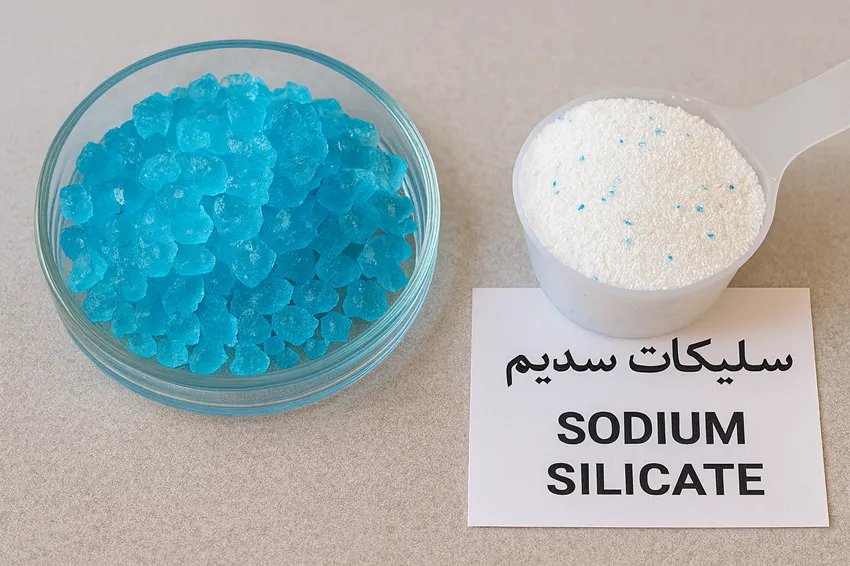
Sodium silicate is an alkaline, water-soluble compound that is used in various industries in the form of liquid sodium silicate or solid sodium silicate. In the detergent industry, this substance falls into the category of builders and corrosion inhibitors, and plays a behind-the-scenes yet very important role.
Based on the experience of the technical experts at Bavand Chemical Company, the most important roles of sodium silicate in detergent formulations are:
·Increasing the alkalinity of the washing liquor and enhancing its ability to dissolve fats
· Helping to neutralize the effect of water hardness (calcium and magnesium ions)
·Forming a protective layer on metals and reducing corrosion in washing machines and industrial equipment
·Contributing to the stability of the formulation and preventing caking of powdered detergents
·Preventing the redeposition of soil and dirt particles on fabrics
For this reason, the use of sodium silicate in detergents is no longer a luxury option; for professional formulations, it is considered a necessity.

The end user usually thinks about questions like:
·Do the stains really get removed?
·Will the clothes become dull or rough?
· Will the washing machine be damaged?
· Is the product suitable for my family’s skin?
If sodium silicate is used correctly and scientifically, it can provide positive answers to all of these concerns.
The manufacturer looks at it from another angle as well:
·Reducing the final production cost without sacrificing quality
· Maintaining consistent quality across different production batches
·Ensuring proper performance in regions with different levels of water hardness
·Compliance with quality and environmental standards
In this context, Bavand Chemical Company, by reliably supplying sodium silicate and providing technical consultancy, helps manufacturers optimize the use of sodium silicate in detergents within their formulations.

In laundry powder, sodium silicate is one of the key components:
·Increasing alkalinity and helping to remove greasy and protein-based stains
·Preventing powder caking in the bag or box
·Protecting the drum and metal parts of the washing machine against corrosion
Many of Bavand Chemical’s industrial customers, in the formulations of their laundry powders, have managed—by correctly adjusting the percentage of sodium silicate—to increase washing performance and reduce the consumption of certain more expensive materials.
In liquid laundry detergent, sodium silicate is used in a controlled dosage in order to:
· Provide strong stain removal while maintaining gentleness on fabric and color
·Control the foam level for automatic washing machines
Especially in “low-temperature” and “quick wash” detergents, the application of sodium silicate in detergents as a performance booster is highly important.
In surface cleaners (floor cleaners, industrial and restaurant degreasers, etc.), sodium silicate:
· Raises the pH of the solution and dissolves old layers of grease
· In properly engineered formulations, prevents severe corrosion of metal surfaces
|
Type of detergent |
Main role of sodium silicate |
Benefit for the consumer |
Benefit for the manufacturer / formulator |
|
Household laundry powder |
Alkalizing agent, anti-corrosion, powder stabilizer |
Stronger washing, reduced deposits and corrosion |
Ability to reduce expensive materials, stable formula |
|
Liquid laundry detergent |
Boosting cleaning power, helping to control foam |
Better cleaning at low temperatures |
Flexibility in designing formulas for different water hardness |
|
Household/restaurant surface cleaners |
Increasing pH, helping dissolve heavy greases |
Deep cleaning of surfaces, removal of old grease |
High performance at lower dosage |
|
Industrial machine detergents |
Anti-corrosion, dispersing contamination particles |
Increased lifespan of equipment and metal parts |
Reduced maintenance costs and production line downtime |
In the alkaline environment created by sodium silicate:
·Fats and oils are more easily broken down and dispersed in water.
·Protein-based stains such as blood, sauce and egg separate more effectively from fabric fibers.
Therefore, in professional formulations, increasing the use of sodium silicate in a targeted way reduces the need for washing at very high temperatures.
Hard water reduces the efficiency of detergents. Sodium silicate reacts with hardness ions and helps:
·Keep surfactants (surface-active agents) free so they can perform better.
·Reduce chalky deposits on clothes and heating elements.
In many of Bavand Chemical’s customer projects in regions with hard water, adjusting the ratio of sodium silicate has noticeably improved washing results.
The anti-corrosion property of sodium silicate helps form a protective layer on metals. The result:
·Reduced corrosion of the drum, heating element and metal parts of the washing machine
·Increased service life of equipment in industrial environments
This provides a serious economic advantage for both household users and industrial plants.
· In high concentrations, sodium silicate is alkaline and can irritate the skin and eyes; in industrial environments, the use of gloves and safety goggles is recommended.
·In the final detergent formulation, the pH and dosage are adjusted so that short-term skin contact during household use remains within the acceptable range.
·Choosing the right grade of sodium silicate from a reliable supplier such as Bavand Chemical Company, and complying with national and international standards, is essential to reduce risks and ensure quality.

One of Bavand Chemical’s industrial customers, a producer of laundry powder, was facing the following challenge:
·Complaints from consumers in some provinces with hard water:
o Stains were not completely removed
o Deposits remained on clothes and on the machine’s heating element
The customer’s technical team, in consultation with Bavand Chemical’s experts, redesigned the formula and:
1.Optimized the percentage and ratio of sodium silicate in detergents alongside zeolite and sodium carbonate.
2.Carried out several series of laboratory and field tests in different regions.
The result:
· Noticeable improvement in stain removal performance at 30–40 °C
·Significant reduction in deposits on clothes and machine parts
·Fewer complaints and higher customer satisfaction in the target provinces
This example shows how using high-quality sodium silicate together with specialized consultancy can directly impact sales and brand image.
If you are also a manufacturer and want to optimize the use of sodium silicate in detergents in your own formula, it is recommended to:
·Analyze the water hardness of your target market.
·Design comparative tests “with” and “without” sodium silicate, or at different percentages.
·Examine the compatibility of sodium silicate with anionic, nonionic surfactants and enzymes.
·Monitor the long-term effect on equipment corrosion and scale thickness.
Bavand Chemical Company, as a producer of sodium silicate in Iran, can not only provide a stable supply of the product, but also support you in selecting the right grade and optimizing the formulation (at this point you can add internal links to pages such as “Bavand Chemical liquid sodium silicate” or “Bavand Chemical solid sodium silicate”).

In this article we saw that:
·Sodium silicate has a direct impact on cleaning power, control of water hardness, protection of equipment and stability of detergent quality.
·The application of sodium silicate in detergents is an important tool for manufacturers to optimize both price and quality.
·Choosing a reputable and specialized supplier, such as Bavand Chemical Company — a producer of sodium silicate in Iran — can reduce production risks and ensure the quality of the final product.
If you are a detergent manufacturer and are looking for:
·A stable and reliable supply of sodium silicate (liquid or solid)
·Technical consultancy to optimize the use of sodium silicate in detergents within your formulation
· Or receiving samples for laboratory testing
Then right now you can:
·Fill out the “Request for sodium silicate quotation and technical consultation” form on the Bavand Chemical Company website,
·Or write your technical question in the comments section of this article so that the technical experts can contact you.