Liquid Sodium Silicate (Water Glass)
Liquid Sodium Silicate: Ready-to-Use Industrial Water Glass
Want stronger cleaning, more stable carton adhesives, more precise foundry cores, and lower-permeability concrete with a single additive? Its name is “water glass” (liquid sodium silicate) the same product that Bavand Chemical, a producer of liquid sodium silicate and among the sodium silicate manufacturers in Iran, has reliably supplied with expert technical support for years. In this quick guide, we’ll explain which grade to buy and how to use it safely and cost-effectively.
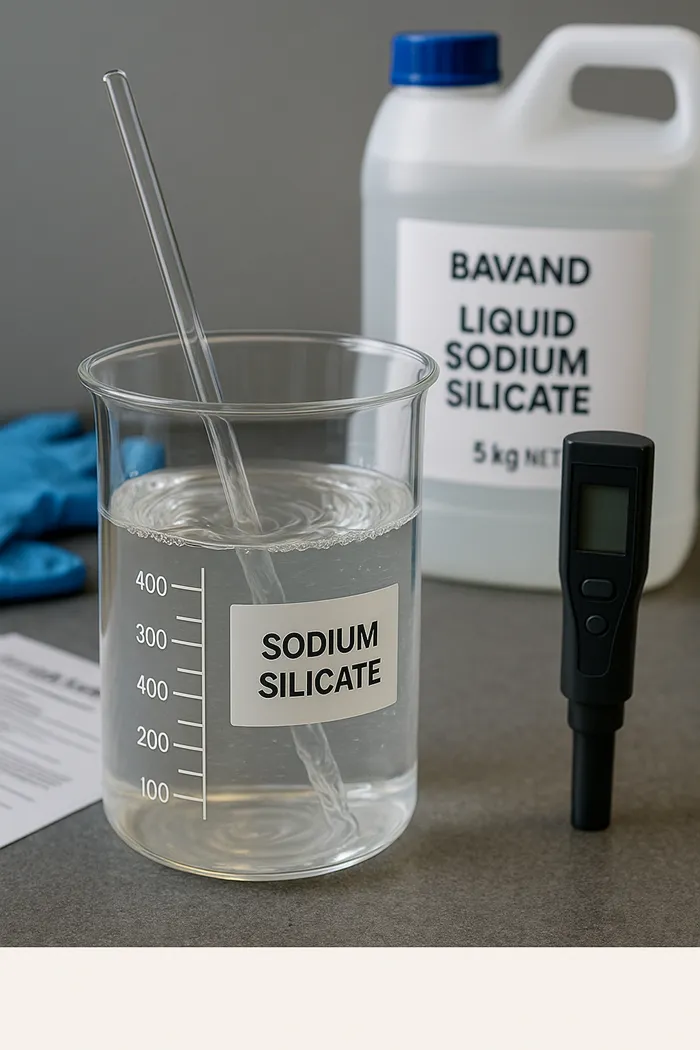
Complete Guide to Liquid Sodium Silicate: Uses, Technical Specs, Formulas, and Buying Tips
What is liquid sodium silicate and how is it different from water glass?
Liquid sodium silicate (Sodium Silicate Solution) is an alkaline aqueous solution of the compound Na₂O·nSiO₂, commonly known as water glass or “waterglass.” It typically contains 35–50% total solids and has a pH above 11, enabling cleaning, dispersion, and formation of silicate layers.
The modulus (M = SiO₂/Na₂O) is its most important quality parameter:
·Low modulus (≈ 2.0–2.4): More alkaline; suitable for detergents.
·Medium/High modulus (≈ 2.4–3.2): Greater tendency to gel/bond for adhesives and binders.
Key point: When selecting liquid sodium silicate, pay close attention to modulus, solids content, and viscosity; these three parameters determine how the product behaves in your process. The Bavand Chemical technical team routinely aligns these three indicators with your specific application.
Why is liquid sodium silicate a professional choice for production lines?
·Ready to use: No dissolution or heating equipment needed (in most applications).
·Formula control: Choose modulus and solids to match the application.
·Safer than many solvents: Non-flammable; cleans up with water.
·Multi-purpose & economical: From detergents and papermaking to carton adhesives, foundry, geopolymers, and water treatment.
·Process-friendly: Operates at ambient to moderate temperatures; good storage stability.
In industrial supply, Bavand Chemical boosts line-level adaptability through diverse grades and formulation support.
Common Technical Specifications of Liquid Sodium Silicate
·Appearance: Clear to opalescent milky liquid
·Total solids: 35–50% (depending on grade)
·pH (10%): ~ 11–13
·Modulus (M = SiO₂/Na₂O): 2.0–3.2 (most common range)
·Viscosity: Depends on temperature, modulus, and solids
·Density: ~ 1.3–1.5 g/cm³ (increases with solids)
Comparison Table: Liquid vs. Solid/Powder Sodium Silicate
|
Feature
|
Liquid Sodium Silicate
|
Solid/Powder Sodium Silicate
|
|
Ready to use
|
Yes
|
No (requires dissolution)
|
|
On-site modulus control
|
Moderate (depends on purchased grade)
|
High (adjustable via water/alkali ratio)
|
|
Transport cost
|
Higher (you’re shipping water)
|
Lower per unit dry substance
|
|
Caking risk
|
Low
|
High in humid environments
|
|
Equipment needed
|
Minimal
|
Reactor/heater/agitation needed for dissolution
|
|
Typical usage focus
|
Detergents, ready-to-use adhesives, fast lines
|
Custom adhesives, specialty binders, geopolymers
|
Quick guide: If you need fast commissioning and process simplification, choose liquid sodium silicate. If transport cost and formulation flexibility are top priorities, consider the solid route. Bavand Chemical supports both paths with technical recommendations and reliable supply.
Main Applications of Liquid Sodium Silicate
|
Industry
|
RATIO
|
Use Cases
|
|
Soap & Detergent Manufacturing
|
2.0
|
Detergency and foam building agent.
|
|
Tile & Ceramic Production
|
2.2 – 2.5
|
Additive for strength and surface gloss.
|
|
Foundry
|
2.2 – 2.4 – 2.5 – 2.6
|
Binder in sand molds; increases resistance to molten metal.
|
|
Papermaking
|
3.2
|
Pulping, bleaching, and de-inking.
|
|
Drilling
|
2.5 – 3
|
Prevents collapse; stabilizes boreholes.
|
|
Nanosilica & Metasilica
|
2 – 2.2 – 3
|
Precursor for production.
|
|
Cement Production
|
2.5 – 3 – 3.2
|
Accelerates drying and bonding in construction projects.
|
|
Paints & Anti-Corrosives
|
2.5 – 3
|
Stabilizer; improves adhesion of paints/primers.
|
|
Textiles
|
3.0
|
Improves stability of dyes and inks.
|
|
Food Colors
|
3.0
|
Extends shelf life and stability of food colorants.
|
|
Antifreeze
|
2.5 – 2.6
|
Lowers freezing point of water-based liquids.
|
|
Chemical Industries & Electroplating
|
Various products
|
Raw material within processes.
|
|
Concrete Construction
|
2.5 – 3 – 3.2
|
Enhances durability of concrete.
|
|
Cosmetics
|
Various products
|
Manufacture of skin creams, hair dyes, and care products.
|
|
Agriculture
|
2.1
|
Extends fruit shelf life; feed supplement alongside fertilizers.
Accordion body...
|
The list below combines baseline applications with lowest-cost improvements across industries. For each case, Bavand can provide an SOP (operating procedure) tailored to modulus/solids.
1) Industrial Detergents & Cleaners
Liquid sodium silicate underpins many detergent formulas thanks to effective alkalinity, degreasing, and dispersion.
·Aids oil emulsion and prevents soil redeposition.
·Corrosion inhibitor for metallic surfaces in alkaline cleaners.
·Substitute/companion to phosphates in low- or zero-phosphate formulas.
Bavand tip: For CIP machines, choose lower modulus (≈ 2.0–2.4) and medium solids to balance cleaning power and corrosion control.
2) Silicate Adhesives & Carton Making
Popular in edge-gluing and liner adhesives due to fast gelation and strong wet strength.
·Non-flammable, economical, easy to clean.
·Suggested modulus: 2.4–3.2 (with viscosity control).
·Can be combined with starch/polymers to tune set time and strength.
3) Foundry & Coremaking
Binder for sand to increase core compressive strength and dimensional repeatability.
·Control of moisture and gassing time improves clean break of castings.
·Suitable for molding at ambient temperature; reduces energy/odor.
4) Construction: Concrete Sealer, Cementitious Grouts, and Geopolymers
·Mineral sealer: Dilute solution penetrates pores, forms insoluble silicate gel, and reduces dusting.
·Grouts/mortars: Lowers permeability and improves durability.
·Geopolymer: Acts as the alkaline activator alongside NaOH/KOH for aluminosilicate networks.
5) Paper & Pulp (including De-inking)
·Improves yield and strength (tensile/tear/compression); provides alkaline buffering in washing/bleaching.
·Aids pigment dispersion and coating uniformity.
·De-inking: Enhances ink detachment and brightness in recycling.
6) Water & Wastewater Treatment (Coagulant Aid & Corrosion Inhibitor)
·Coagulant aid for floc formation; reduces metallic coagulant dose and sludge.
·Forms a protective silicate film on metal surfaces in industrial water lines.
7) Refractories & Heat-Resistant/Fireproof Coatings
·Mineral binder for refractory castables and water-borne fireproof coatings.
·After cure, becomes more insoluble and stable with very low smoke/odor/VOC.
8) Tile & Ceramic
·Binder and rheology modifier for slurries; reduces dry-/firing-cracks.
·Improves surface uniformity and glaze/coating adhesion.
9) Textiles
·Promotes dyeing uniformity; improves dye adhesion.
·Reduces equipment corrosion compared with some metal salts.
10) Food Industry (approved grade) – Anti-caking / Flow Aid
·Used in milk powder, spices, and additives to prevent caking and improve packaging.
·Must meet food-grade requirements and usage limits.
11) Oil & Gas Drilling (Drilling Mud)
·Controls viscosity and mud permeability; stabilizes borehole walls via silicate networks.
·Boosts operational stability under challenging geological conditions.
12) Protective Industrial Coatings (e.g., conveyors/metal surfaces)
·Mineral layer with abrasion/corrosion resistance and chemical/thermal durability.
·Strong adhesion to metal/concrete; water-borne application.
13) Production of Nanosilica/Metasilica (as Precursor)
· Tight control of particle size and properties for coatings, catalysts, and refractories.
·pH/ionic strength can be tuned for target morphology.
14) Briquetting of Metal Powders
·Improves particle bonding; reduces dust and energy use.
·Suitable for iron/ferro-alloys in reduction/melting processes.
15) Welding Electrode Coating Paste
·Binder/stabilizer of the coating to ensure uniform adhesion and steady current transfer.
·Aids shaping and mechanical strength of the coating.
16) Cosmetics & Personal Care (in some water-based formulations)
·Thickener/stabilizer of the aqueous phase in emulsions.
·Requires appropriate grade selection and skin-compatibility evaluation.

How is liquid sodium silicate produced?
1.Raw materials: Silica (SiO₂) of suitable purity + alkali (sodium carbonate or caustic soda).
2.Fusion: High-temperature melting to form silicate glass.
3.Controlled dissolution: Glass is dissolved in water; modulus and concentration are adjusted.
4.Filtration & QC: Particle removal and monitoring of pH, viscosity, and solids.
At this stage, Bavand Chemical ensures batch-to-batch consistency for industrial customers by tightly controlling modulus.
Safety, Storage, and Transportation
·Alkaline: Use goggles, gloves, and workwear; in case of eye/skin contact, rinse immediately with plenty of water.
·Store in polyethylene/fiberglass tanks; avoid prolonged contact with aluminum in alkaline environments.
·Freezing/overheating can change viscosity and performance; store at 10–30 °C.
·During transfer, use in-line filtration and alkali-resistant hoses. Bavand’s logistics team supports IBC, drums, and bulk packaging.
Selection & Purchasing Guide (Commercial/Transactional)
Quick checklist for buyers:
·Application: Detergent? Carton adhesive? Foundry? Concrete sealer? Tile/ceramic? Textile? Drilling? Food/cosmetics?
·Modulus: 2.0–2.4 for detergents; 2.4–3.2 for adhesive/binder/sealer (project-specific tuning possible).
·Solids: 35–50%; higher solids = more efficiency, but higher viscosity.
·Viscosity & temperature: Must match your line conditions.
·Local water quality: Hardness/minerals affect performance.
·Documentation: SDS, CoA, and technical guide.
·Packaging: Bulk/iso-tank, IBC, drums.